The Canucks probably want to put the 2025-26 season behind them completely, but carrying over the momentum their power play built towards the end of the year would be a welcome sight.
When the Canucks traded Quinn Hughes in December, many fans expected the already middling power play to take a step back. Before he was dealt, Hughes had 33 more power play points than the next closest Canuck over the prior three seasons. Instead, the opposite happened.
After Jan. 1, the Canucks’ power play was a top-10 unit in the NHL for the rest of the season. After March 1, it was the best power play in the league, operating at a 34.5 per cent clip to finish the year. The unit underwent a number of adjustments after Hughes left, but the biggest change was Filip Hronek taking over as the quarterback on PP1. Hronek didn’t try to replicate what Hughes did. He created offence in a different way.
Hughes could create advantages almost entirely through his individual skill. His skating allowed him to open shooting lanes that most players wouldn’t be able to find, and his ability to get pucks through traffic made him a constant threat from the point.
Hronek, on the other hand, was much more of a traditional power play quarterback. Rather than constantly looking for his own shooting lane, he used the threat of his shot to manipulate the penalty kill and create opportunities for the four players around him. That subtle difference seemed to make Vancouver’s power play more difficult to defend.
Without Hughes as the primary source of offensive creation, the rest of the power play personnel had to become more aggressive in looking for chances to make plays. When Hronek was placed on that unit, the puck seemed to move quicker around the zone. Here is a perfect example of this. Florida blows their coverage, leaving Hronek a wide-open lane to shoot. However, rather than taking a shot on Bobrovsky, who is already squared up to the puck, he passes to Pettersson, which creates a great chance.
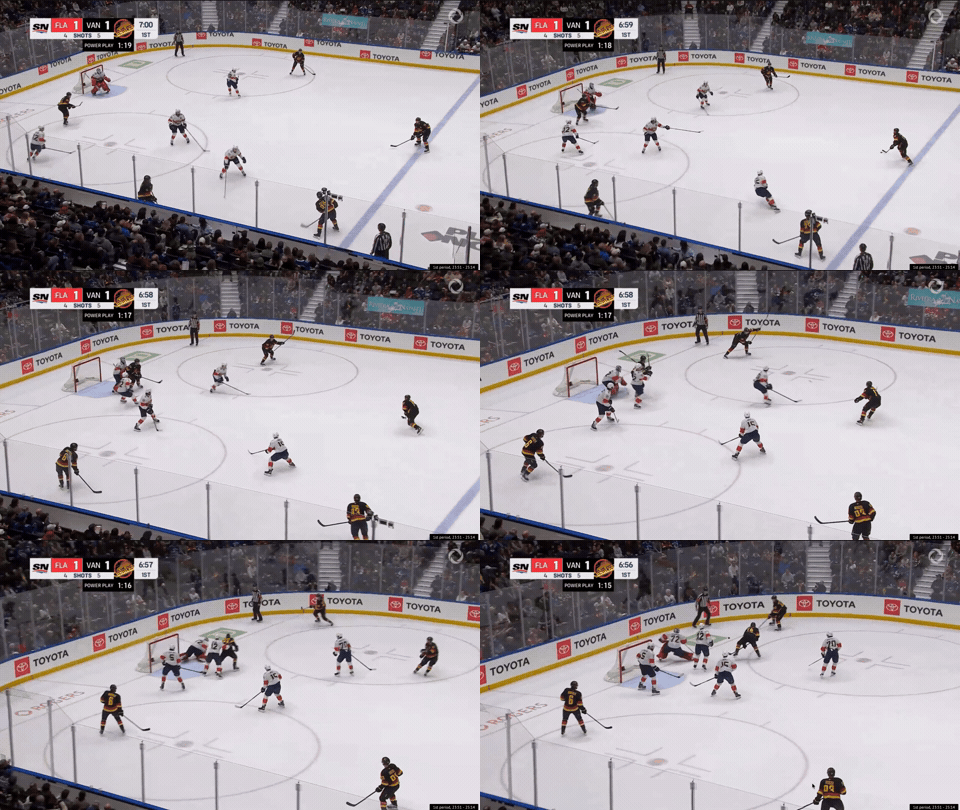
That quick puck movement became one of the most noticeable differences in the Canucks’ power play. Also, notice that even though Bobrovsky wasn’t screened and the shot hit him in the chest, a rebound was created. In general, goaltenders are able to control rebounds much better when they are set than when they are moving side to side. Vancouver’s east-west passing forced opposing goalies to constantly adjust their positioning, meaning that even an ordinary shot could turn into a dangerous rebound. We see that here, where the Canucks move the puck from side to side before Hronek eventually takes his point shot. Askarov isn’t fully set when the shot comes through, and even though it isn’t particularly well placed, he gives up a rebound that Jake DeBrusk cleans up in tight.
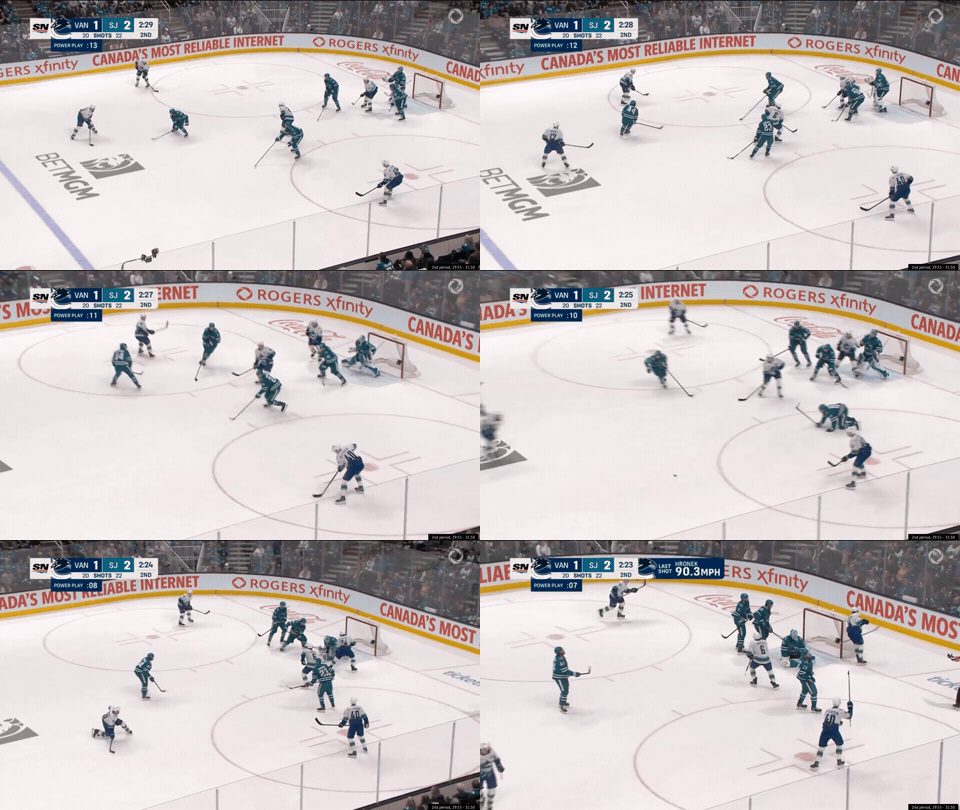
Hronek’s success wasn’t just about moving the puck quickly, though. A big part of his effectiveness came from knowing when to hold onto it. Because Hronek spent so much time playing alongside Hughes, it feels like his own offensive prowess was overshadowed during his first few seasons in Vancouver. Offensive play-driving was one of his calling cards during his time in Detroit, and his poise with the puck along the blue line was evident even under heavy pressure.
We see that here, where Hronek comes under heavy pressure off the faceoff. The defender tries to cut him off in the middle of the ice at the blue line. A lesser player might look for a quick pass to Marco Rossi just to avoid a turnover. Instead, Hronek takes an extra stickhandle, freezes his defender, and creates a passing lane to a wide-open Elias Pettersson in the slot. That extra second is all it takes.
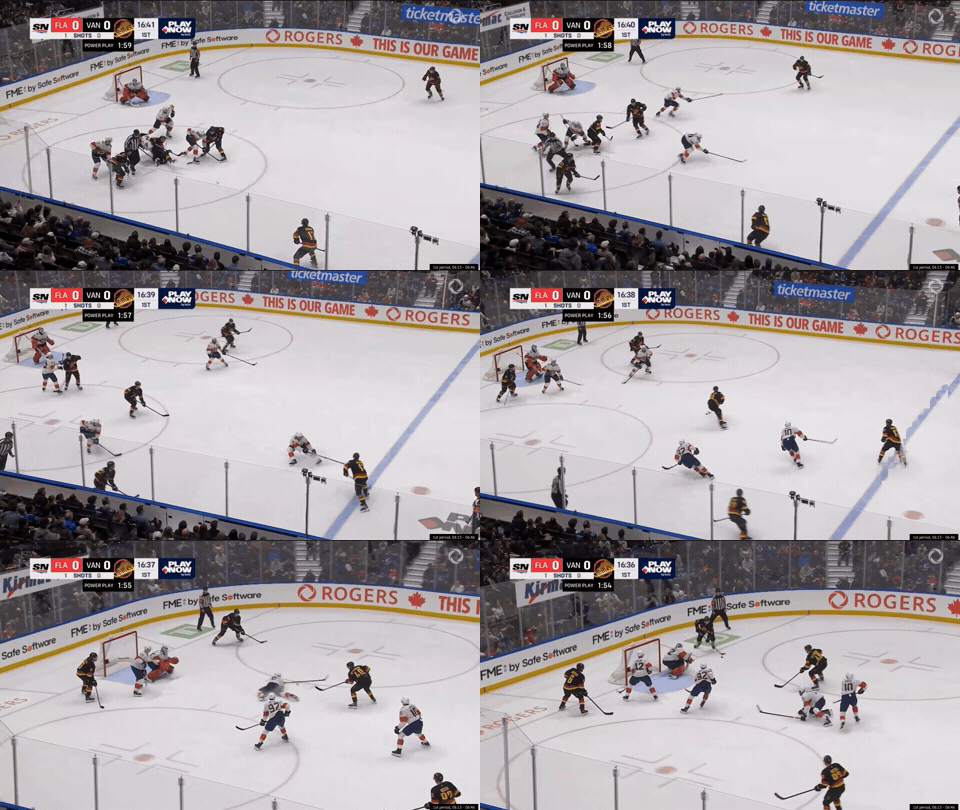
Power play passing lanes can exist for less than a second before a defender closes them. The best power play quarterbacks aren’t necessarily the players who can make the most difficult play. They’re the ones who can recognize when a difficult play is about to become an easy one. Hronek consistently showed that ability.
Speaking of Pettersson, having him on his off-wing has been a staple of the Canucks’ power play for years. Hronek gave him another one-timer passing option from the blue line whenever Pettersson had the puck on the half-wall. With Brock Boeser at the bumper and Hronek as a right-handed shot at the point, Pettersson typically had two active shooting threats whenever he had the puck along the boards, as we see here. That created strain on the penalty-killing wingers, who had to defend higher in the zone than usual to prevent those quick passes.

Hronek and Pettersson also seemed to have natural chemistry together on the man advantage. The two did a great job of switching when necessary to manipulate the point-of-attack defender into committing too much to one side. Here we see Pettersson and Hronek switch positions, but the Kings’ wingers don’t do the same, instead sticking to their original assignments. Because of the pair’s movement, Pettersson’s defender unintentionally sets a pick on Hronek’s defender, opening a passing lane to DeBrusk on the goal line.
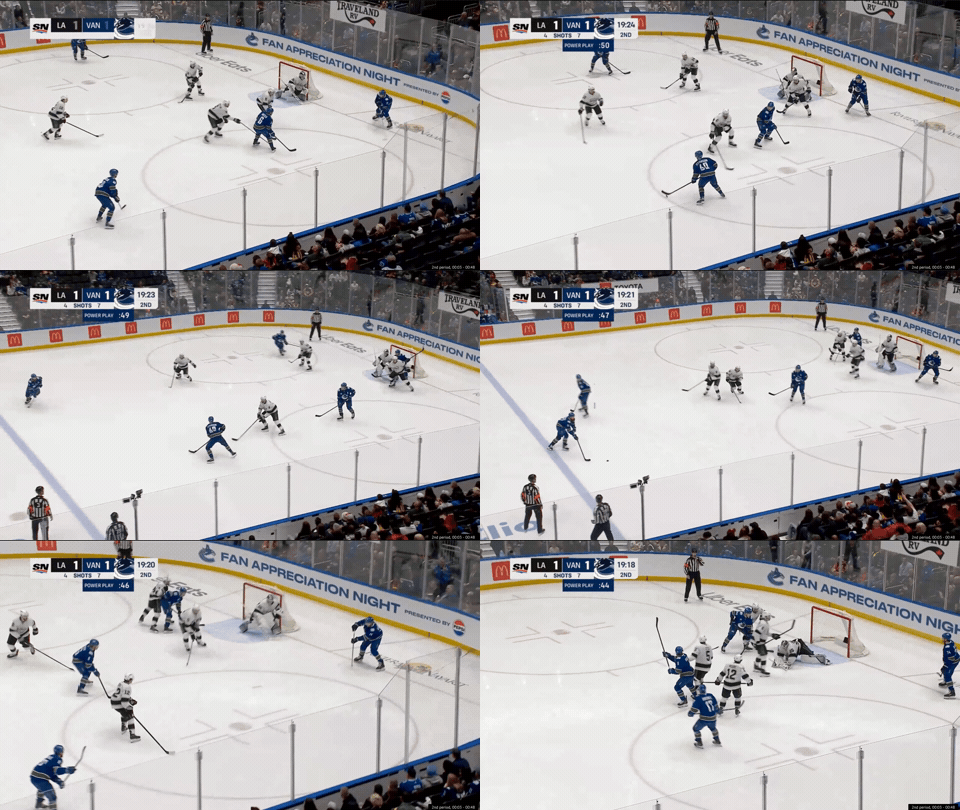
It’s a relatively simple play, but that’s exactly what made Hronek so effective. He wasn’t trying to beat every defender one-on-one. He was reading how the penalty kill was reacting and moving the puck or himself into the space it gave him. The results were hard to ignore.
Hronek led all defencemen who played at least 150 power play minutes last season with 7.94 points per 60 minutes. Vancouver’s power play didn’t just look better with him in the quarterback role. It became significantly more productive. It’s interesting that the Canucks didn’t know exactly what they had in Hronek as a PP1 quarterback until circumstances forced them to find out. Now, with Zeev Buium likely being the power play quarterback of the future, Vancouver will eventually have to decide when to give him the opportunity to take over that role. Hronek’s success could provide a useful blueprint.
Buium has the skating ability and puck skills to develop into a great offensive defenceman. At this point, though, he can still fall into the trap of forcing shots through traffic when there is a better play available. In this screenshot, we see a defender commit to Buium in an attempt to take away his shooting lane.

Rather than moving the puck over to Tom Willander, who would have a mini three-on-two opportunity coming down the wing, Buium forces the shot through traffic, resulting in a relatively easy pad save.
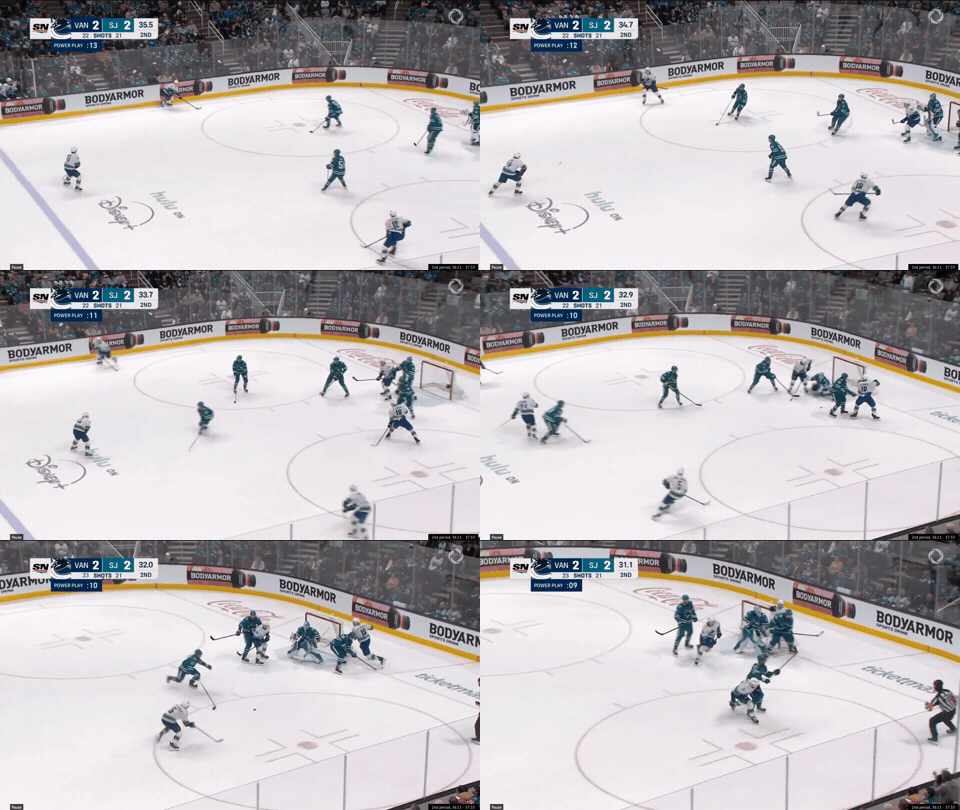
That isn’t necessarily a major issue for a young defenceman with Buium’s skill set. But Hronek’s emergence showed that being an efficient play driver has more to do with reading plays and taking advantage of mistakes than it does beating guys one-on-one. Passing and shooting lanes are typically open for about half a second. The ability to see those openings instantly, or even before they open up, is what allows the best defencemen in the NHL to dominate the game. That could be an important lesson for Buium.
His offensive talent is obvious, but becoming Vancouver’s next power play quarterback will require more than spectacular individual plays. Sometimes the best decision is the simple one — moving the puck at the exact moment a defender commits, creating movement and trusting the opportunity will follow. That is what Hronek showcased after Hughes left.
The biggest takeaway from his emergence on the power play is that replacing Hughes was never going to be about finding another player who could replicate his individual skill set. It was about finding a defenceman who could make the other four players on the ice more dangerous. Hronek’s ability to read the penalty kill, move the puck quickly, and recognize when a passing lane was about to open allowed Vancouver’s power play to become less predictable and, ultimately, more efficient.
Hughes made the Canucks’ power play dangerous through individual brilliance. Hronek showed that it could be just as dangerous when the quarterback’s biggest job was making everyone else better. Now, Vancouver will have to hope Buium eventually learns how to get the best of both worlds.